



Leadership Insight
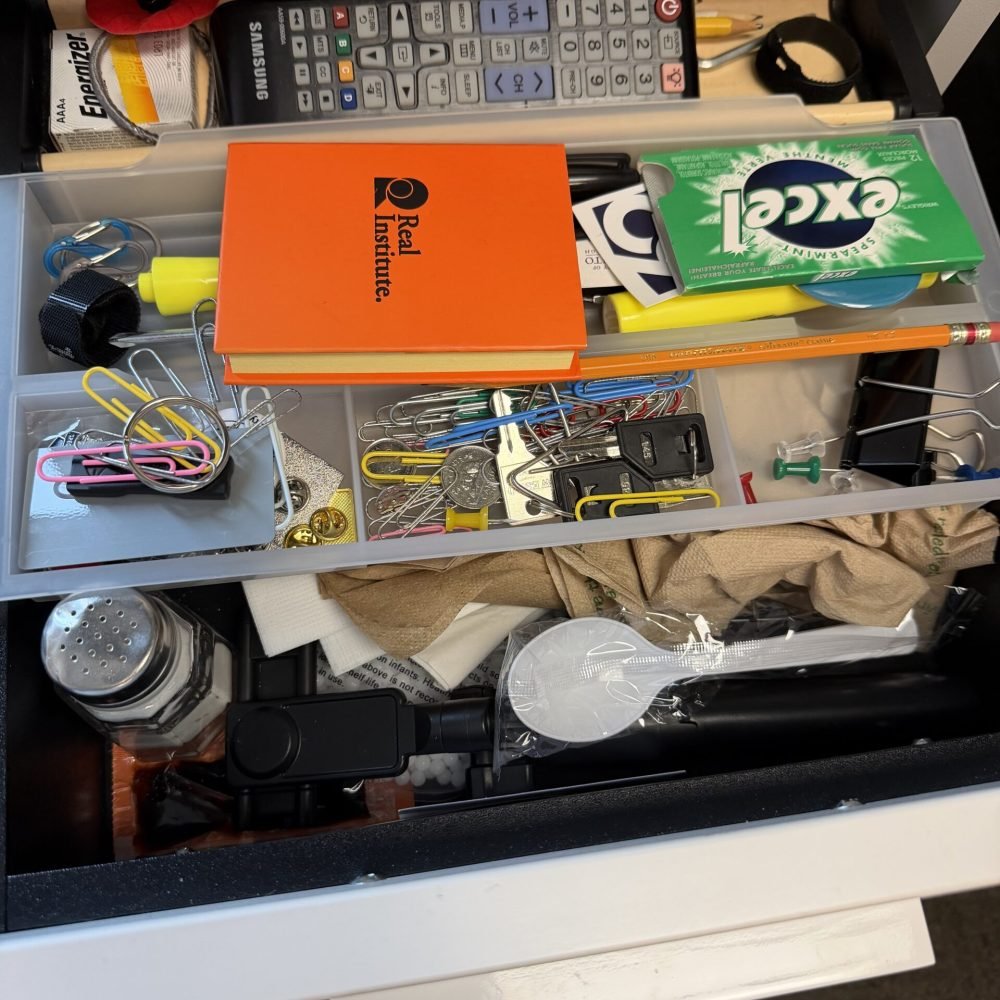
Leadership Starts In Your Junk Drawer
Willow Roots Leadership · willowrootsleadership.ca
Think decluttering is just about tidy shelves? Think again. The act of clearing your physical space is one of the most practical leadership labs you’ll ever enter — and most executives completely overlook it.
Every item you touch — a stack of old reports, a drawer of “just in case” cables, a closet full of “maybe one day” clothes — forces a high-stakes decision: keep or release? That’s not housekeeping. That’s a rigorous daily exercise in logic, priority, and emotional strength.
The leaders I work with are often surprised by what surfaces when they slow down enough to sort through physical space. Not just clutter — but clarity about who they are and what they’re still carrying from roles, identities, and ambitions that no longer serve them.
Every great leader I’ve coached knows what to let go of — in their closet and in their organization. The skill is the same.
1 Why Decluttering Is a Leadership Practice
There’s a reason high-performance organizations like the military, elite sports teams, and world-class hospitals are obsessed with stripped-down environments and clear accountability — cognitive load kills performance. Every unnecessary decision you make before the important one depletes the mental resources you need to lead well.
Decluttering trains the exact cognitive and emotional muscles that leadership demands every day. Here’s how each skill maps directly to the boardroom:
Decision Velocity You learn to stop procrastinating on “small” choices. Moving through a junk drawer requires the same mental muscle as pruning a project portfolio or cutting a budget line that no longer delivers.
Signal vs. Noise When you clear physical noise, you train your brain to spot what actually matters. That same filter shows up every morning when you open your inbox or walk into a team meeting.
Courage to Change Letting go of things that no longer serve you builds the grit to pivot a team strategy or sunset a failing initiative — even when it’s uncomfortable, even when you built it yourself.
2 The Physical–Professional Parallel
The most powerful insight from this practice is recognizing how often our physical environments mirror our professional ones. The same resistance that keeps a worn-out jacket in your closet is the same resistance that keeps an underperforming process on your team’s workflow.
| In Your Closet | In Your Organization |
|---|---|
| “I’ve had this for years. It might come back in style.” | “We’ve always done it this way. It might be useful again someday.” |
| “I keep it because letting go feels like admitting defeat.” | “We can’t cancel this initiative — too much has already been invested.” |
| “It doesn’t fit anymore, but maybe I’ll fit it again one day.” | “This role doesn’t match our direction, but we’ll figure it out eventually.” |
Notice a pattern? The story you tell yourself about the shirt is the same story you tell yourself about the process. Learning to see and interrupt that story in your physical space is training for interrupting it where it matters most.
3 The Annual Leadership Audit
I advocate treating decluttering as a vital annual audit — not just of your home, but of every system, habit, and commitment you’re carrying. Most leaders evaluate their teams, their financials, and their strategy on a regular cycle. How many evaluate themselves with the same rigor?
If you aren’t regularly auditing your environment — physical and professional — how can you be certain you’re still building toward the right goals? The world changes. Your team changes. You change. Your systems should too.
The Annual Reset: Hard Questions Worth Asking
Use this process to get honest with yourself — and your organization.
- Is this process, project, or commitment still generating real value — or am I holding onto it out of habit?
- Are my goals still aligned with where I want to take this organization in the next 18 months?
- What am I holding onto simply because “that’s how we’ve always done it”?
- What would I eliminate tomorrow if I were starting fresh — without the weight of sunk costs?
- Is this role, relationship, or responsibility still a good fit for the leader I’m becoming?
4 A Practical Framework to Get Started
Transformation doesn’t begin with a grand gesture. It begins with a single drawer. Here’s a simple three-stage framework I use with coaching clients — applied both to their physical spaces and their professional ones:
Stage 1: Inventory Don’t start by throwing things out. Start by seeing what you actually have. Take stock with curiosity, not judgment. What’s here? How long has it been here? Is it still being used?
Stage 2: Evaluate Apply a consistent filter: does this serve where I’m going — not where I’ve been? If yes, keep it. If not, release it. Resist the urge to create a “maybe” pile.
Stage 3: Recommit With the space cleared, ask: what needs to fill it intentionally? The goal isn’t emptiness — it’s intentionality. Rebuilt systems and spaces are more energizing than inherited ones.
Apply this same framework to your team’s workflows, your strategic plan, and your personal development. The muscle you build in Stage 2 — making a clean decision without over-deliberating — is one of the most valuable skills in leadership.
5 The Challenge: Start Where You Are
You don’t need a weekend retreat or a professional organizer to begin this work. Start with your desk. Then your inbox. Then the meeting that’s been on the calendar for six months without a clear outcome. Then the project your team has been quietly dreading but hasn’t had the language to stop.
Every great leader I’ve worked with knows — at some level — what needs to go. What’s harder is giving yourself permission to let it.
Decluttering is that permission slip. It’s proof that you can make the hard call, feel the discomfort of releasing something familiar, and be better for it on the other side.
Clear the clutter today.
Make room for the leader you’re becoming.
Ready to Go Deeper?
If this resonated, it might be time to take a more structured look at what you’re carrying — professionally and personally. That’s exactly what the Leadership Circle Profile™ (LCP) reveals.
willowrootsleadership.ca
